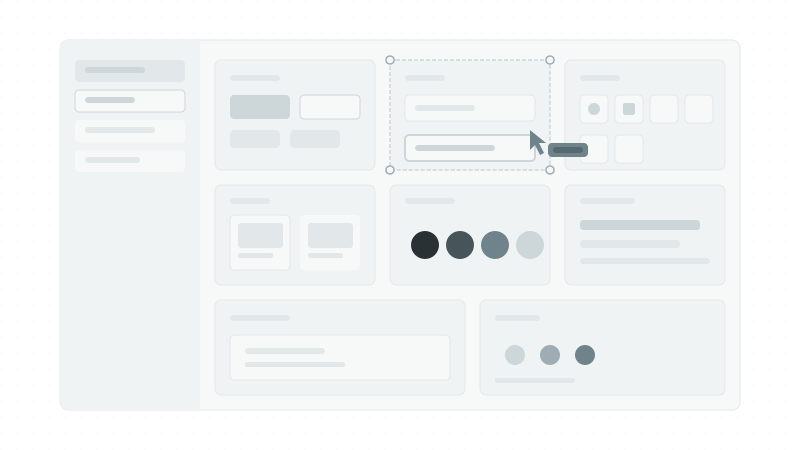
B2B SaaS products face a unique challenge: they must handle complex workflows while remaining accessible to users with varying levels of expertise. Design systems address this challenge by providing a foundation for consistency and scale.
The Case for Systems Thinking
Most B2B products grow organically. Features are added to solve immediate problems, designed by different people at different times. The result is inconsistency—buttons that look different across screens, interaction patterns that vary without reason, visual styles that drift over time.
This inconsistency has real costs. Users must relearn patterns as they navigate your product. Engineers spend time recreating components that already exist elsewhere. Design reviews catch problems that should have been prevented by clear standards.
What a Design System Provides
A design system is more than a component library. It’s a shared language for how your product looks, feels, and behaves. It includes:
Components — Reusable interface elements with documented states, variants, and usage guidelines.
Patterns — Established solutions for common problems: how to handle empty states, how to structure forms, how to display data tables.
Foundations — The underlying systems that create visual coherence: color palettes, typography scales, spacing frameworks.
Documentation — Clear guidance on when and how to use each element, so decisions are made consistently across teams.
The Investment Pays Off
Building a design system requires upfront investment. But the returns compound over time:
Faster development — Engineers can build with pre-made components instead of creating from scratch. Design reviews focus on product decisions, not pixel-level feedback.
Better quality — Accessibility, responsiveness, and edge cases are handled once in the system, not repeatedly in every feature.
Easier scaling — New team members can ship quality work faster because the system teaches them your standards.
Consistent experience — Users encounter familiar patterns throughout your product, reducing cognitive load and increasing confidence.
Starting Points
You don’t need to build a complete system before seeing benefits. Start with the components you use most often: buttons, form elements, typography, spacing. Document them clearly. Create a single source of truth.
As your system grows, it becomes the foundation for everything you build. The investment in systematic thinking pays dividends with every feature you ship.